










|
|
JOANA VASCONCELOSTRANSFIGURACIÓN MUSEO PICASSO MÁLAGA Palacio de Buenavistarn. Calle San Agustín, 8 29015 Málaga 29 MAI - 27 SET 2026
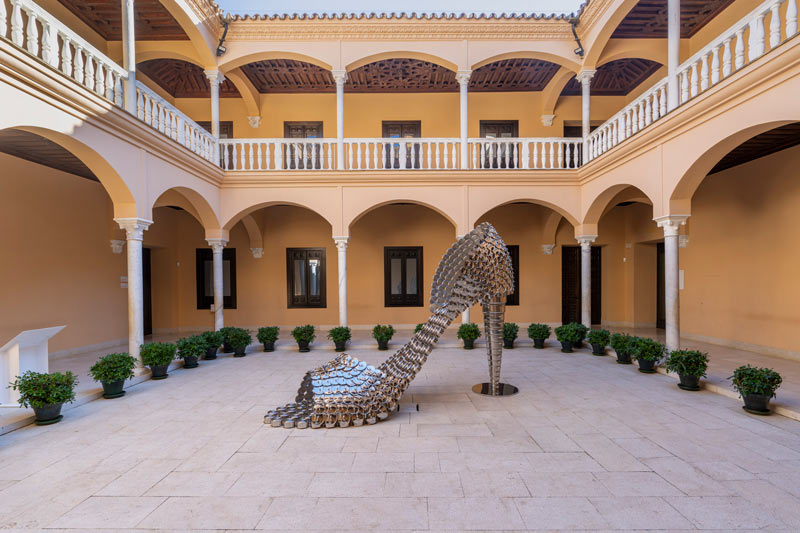
Like the wider region of Andalusia, Málaga bears the strong imprint of its Arab heritage, with the Alcazaba fortress—built between the 11th and 14th centuries during the Islamic period—standing as one of its most enduring landmarks. As the birthplace of Pablo Picasso, the city is also home to his museum and former residence: a two-storey, 8,300-square-metre building in the historic centre, known as the Picasso Museum. At its core lies an open-air courtyard, around which the structure unfolds in a near-perfect square, guiding visitors through a sequence of entrances and passages. The museum houses paintings and sculptures by the iconic Spanish artist, many drawn from his private collection and little known to the wider public. From 28 May to 27 September, the experience extends to the second floor, where, over the sunlit ground level, visitors encounter Joana Vasconcelos’s emblematic high-heeled shoe, Betty Boop. Composed of more than a hundred stacked pots rising in a vertiginous ascent, the monumental piece is shown alongside twelve other works by the Portuguese artist, spanning the past three decades. The exhibition is curated by Miguel López-Remiro under the concept of Transfiguration.
**
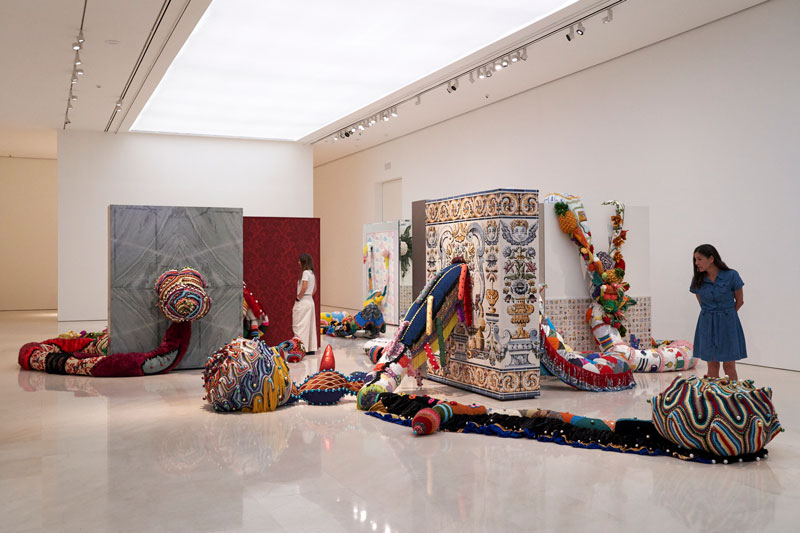
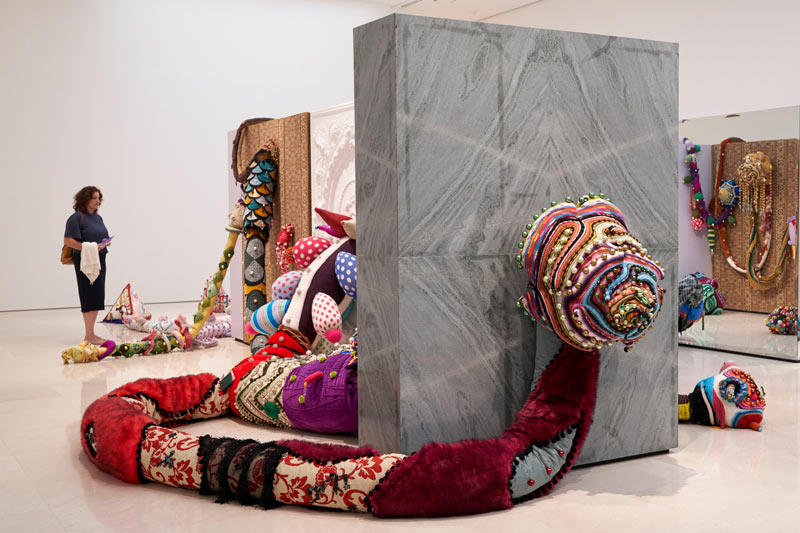
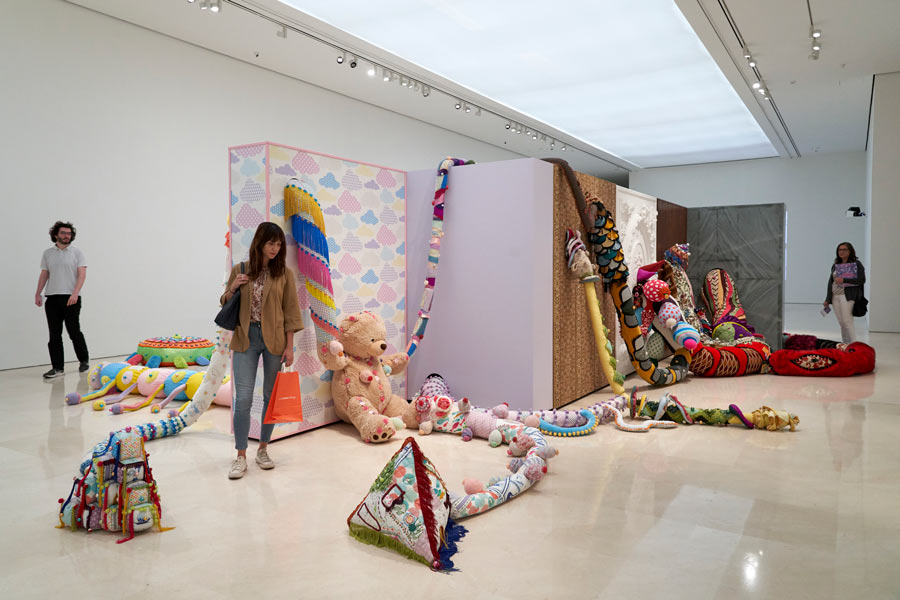
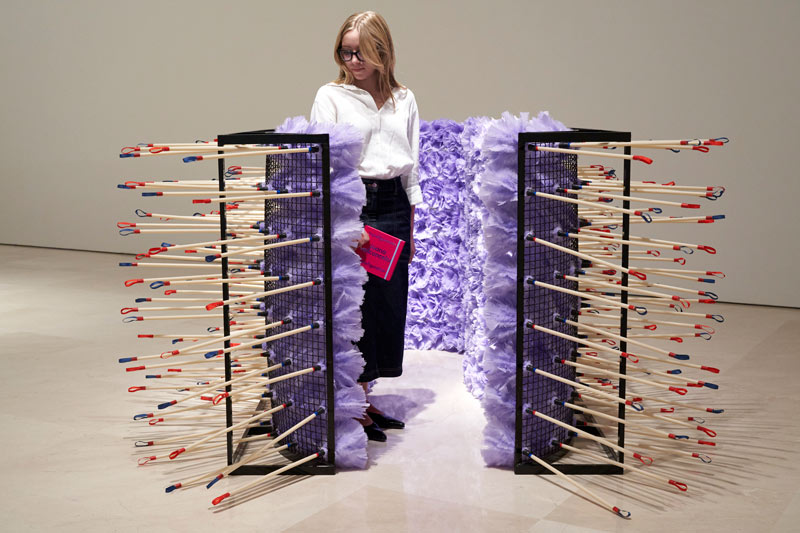
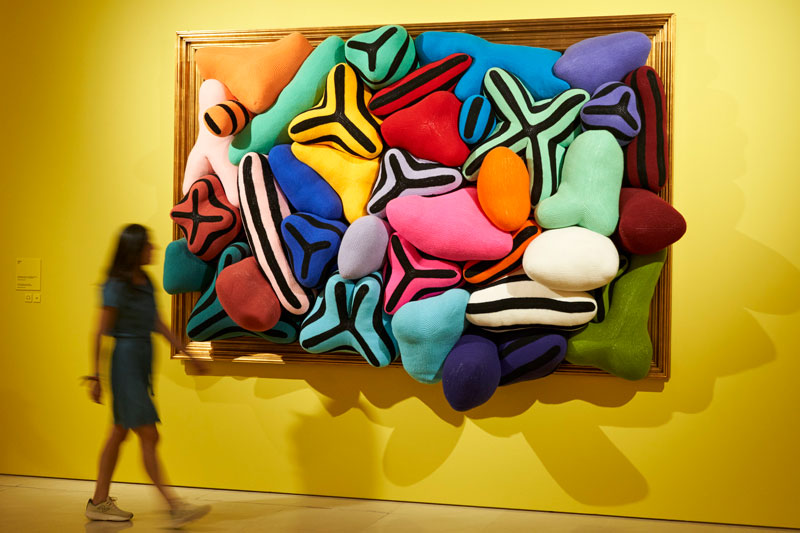
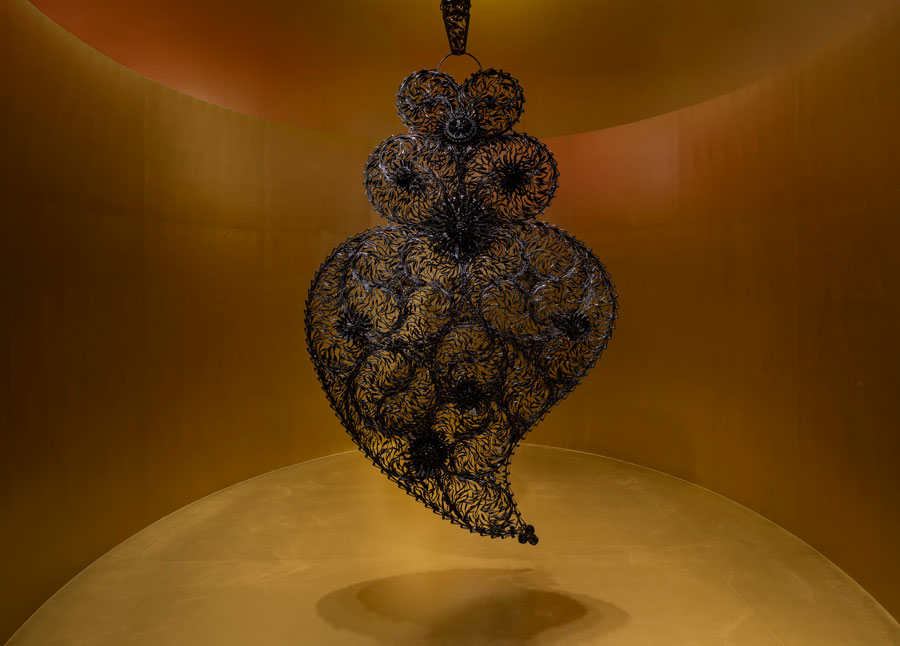
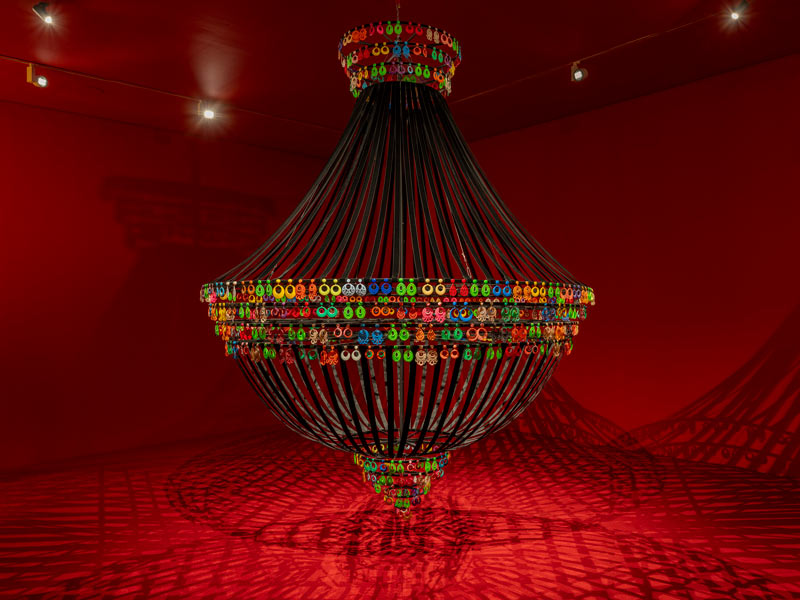
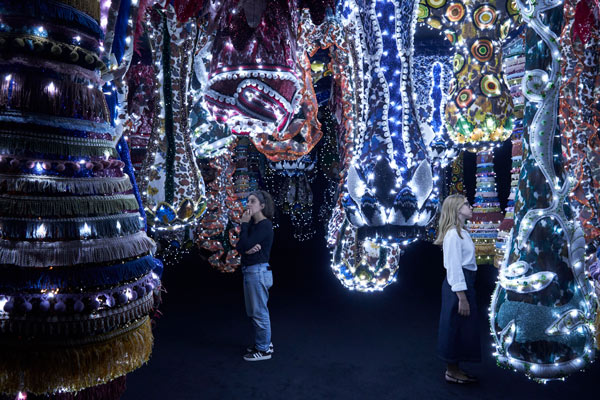
Joana Vasconcelos transcends her country of origin, drawing audiences from across continents. During the two-day opening of her exhibition, the Picasso Museum was filled to capacity, leaving no doubt as to the artist’s reach and recognition. Alongside her works, she seems to extend the museum itself, redrawing it in new dimensions; the public, in turn, becomes absorbed into the monumental scale—both physical and symbolic—of her practice. On the second day of the event, the artist led an active, guided meditation with visitors and museum staff, generating a collective synergy around the opening. More than a display of thirteen works, Vasconcelos’s presence at the Picasso Museum stages a strange and unavoidable dialogue with its architecture. Her pieces do not simply occupy the space; they assert themselves within it, transforming it into something other than what it was. They are not merely received by the museum but appropriate it in a kind of phagocytic gesture, radically reconfiguring it into an immersive environment. This dynamic is epitomized by Enchanted Forest, originally presented in Hong Kong and recreated specifically for Málaga: an installation of eighty-three suspended elements, handcrafted and illuminated by LED light against a darkened field, evoking an ethereal woodland composed of fabrics from the French house Dior. The works, spanning three decades of the artist’s practice, are brought together under the curatorial concept of Transfiguration. The title, drawn from the biblical episode of the Transfiguration of Christ, replaced an earlier, more nationally inflected proposal that would have named the exhibition “Portugal.” Rather than foregrounding a cultural or national framework, the curators ultimately opted for what they understood as the common ground between Vasconcelos and Picasso: the transformation of form itself—the reconstitution of figurative objects from shifting perspectives. This affinity emerges from the curatorial reading that Picasso’s transformation of pictorial perspective resonates with Vasconcelos’s own practice of assembling monumental forms from pre-existing objects, whereby both the whole and its constituent parts undergo simultaneous semantic displacement. In her more figurative works, such as Betty Boop (2019) or Independent Heart (2006), one can observe a similar dissolution of the original symbol through the intensification of the elements that compose it. Approaching Vasconcelos’s work, one realizes that one is not merely confronted with emblems of luxury or national identity; rather, these symbols are unsettled, subjected to an ironic reversal in which forks and knives, for instance, become the material substrate of sculptural form, displacing their own conventional meanings. Yet while Picasso operates within a crisis of representation, interrogating the very construction of the image and the modern figure of the artist, Vasconcelos shifts attention toward the production, circulation, and institutional embedding of objects, exposing the material infrastructures that sustain visibility itself. Much of her work—the chandelier made of plastic earrings, the shoe constructed from pots, the Coração Independente assembled from cutlery—foregrounds the labour of its own making, producing a tension, or at least a moment of estrangement, in the viewer confronted with the transformation of everyday detritus into monumental form. In doing so, she also expands the scope of artistic practice, which here depends on an extensive network of artisans, suppliers, materials, and procedures. The dialogue with Picasso thus emerges not simply as a conversation between artists, but as an encounter between distinct historical sensibilities and regimes of practice. Vasconcelos does not seek to escape the dense materiality of contemporary life; rather, she inhabits it fully, using it as both medium and method, an aesthetic proposition and a symbolic reconfiguration of the relationship between artwork, museum, and spectator. In doing so, her work becomes a nodal point within a wider system of circulation, where objects, actors, and processes converge in the production of artistic form.
**
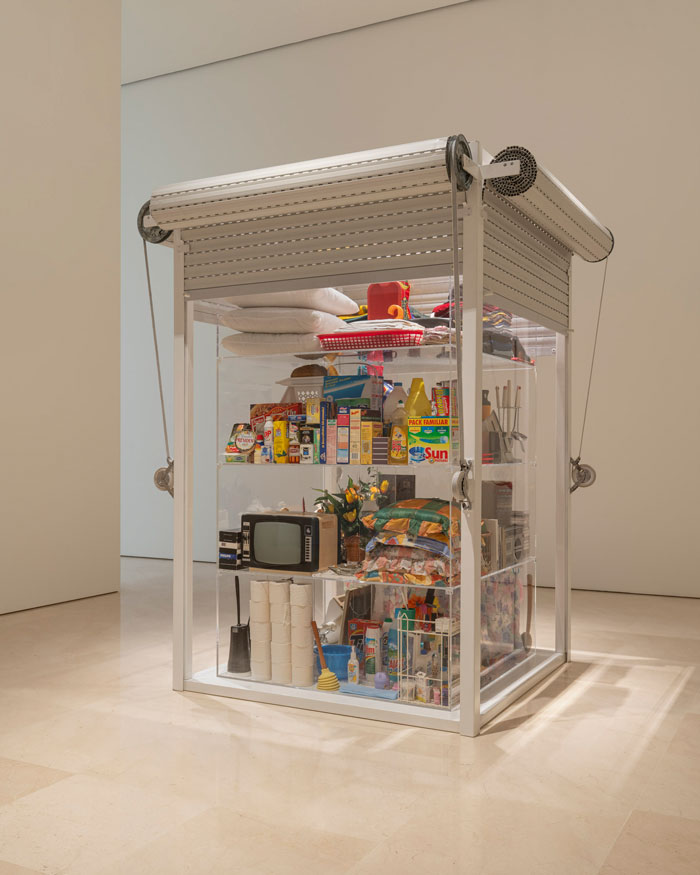
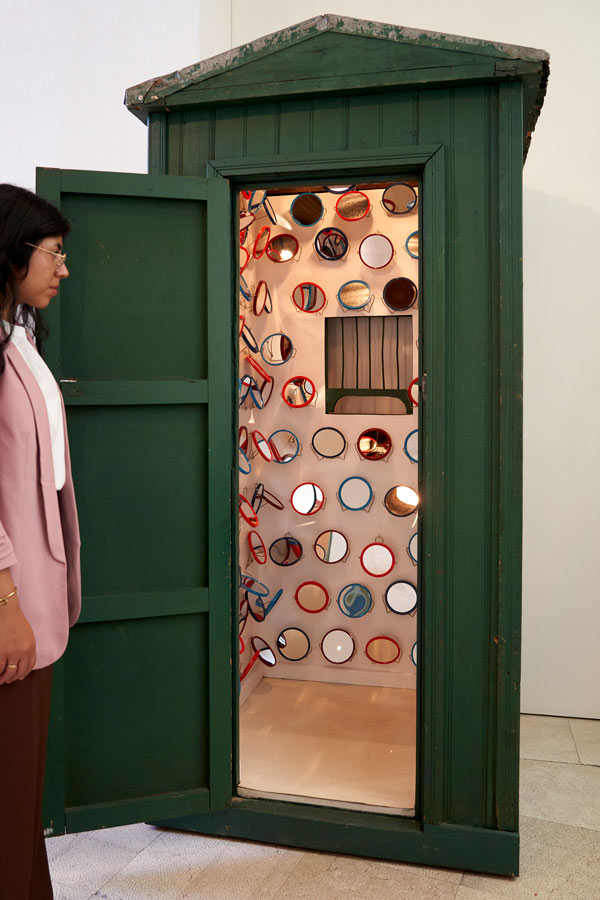
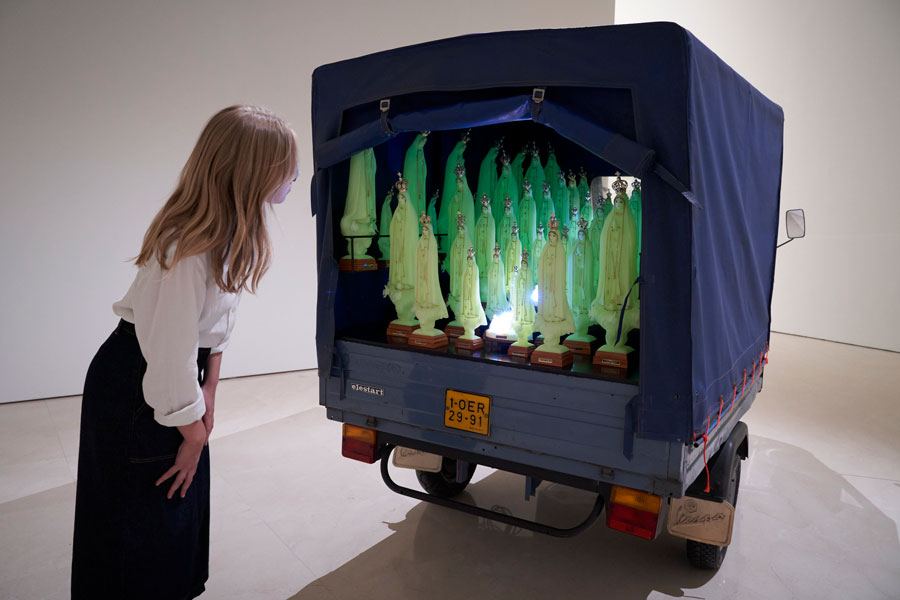
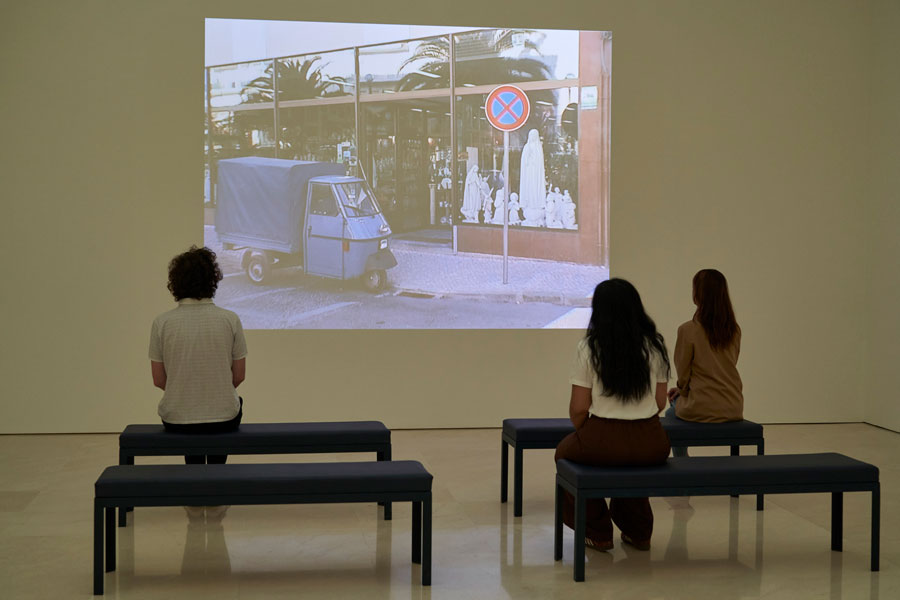
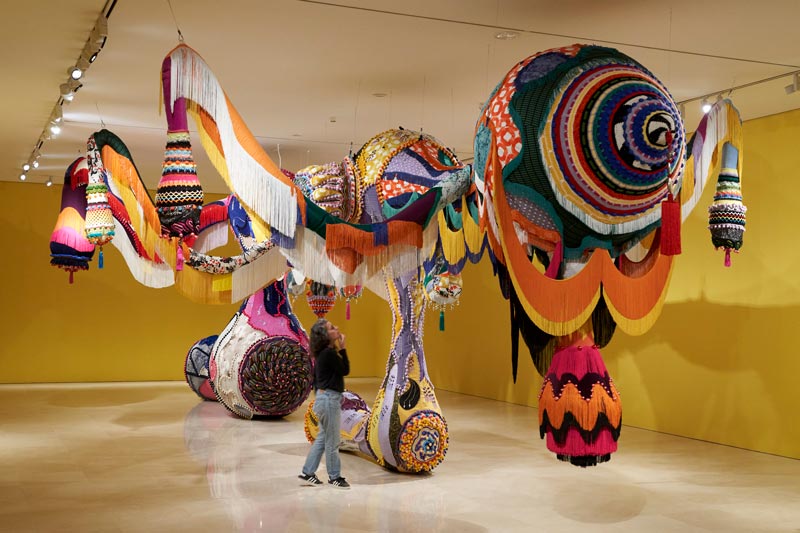
Although Transfiguración was chosen as the title of the exhibition, a large portion of Vasconcelos’s work remains an expression of, and an inescapable dialogue with, Portuguese culture. This is the case in Spot Me (1999), a wooden guardhouse used at the National Stadium during the Estado Novo as a surveillance post and checkpoint. The artist covered its surfaces with more than a hundred small circular plastic mirrors. The confined space, together with the scale of the mirrors and their shifting angles, produces a suffocating effect while simultaneously preventing the emergence of any stable image. According to the artist, the work gestures toward Portugal’s difficulty in seeing its own reflection. The same can be said of Interior View (2000), a constellation of domestic objects arranged side by side within an acrylic glass case. It offers a compact exploration of interiority and a snapshot of the Portuguese domestic world, including an obsolete television set, lending the piece a character that is at once archaeological and quotidian. Or of the more emblematic www.fatimashop (2002), an installation composed of a road video documenting the artist’s journey to Fátima, alongside the objects acquired there, translated into fluorescent green “glow-in-the-dark” statues of Our Lady of Fátima, installed within a small trailer as if in a makeshift altar. The work constructs a portrait that is at once critical and ambivalent, reflecting on the experience of the sacred within a regime of consumer circulation. Constantly working with everyday objects and a kitsch aesthetic, Joana Vasconcelos shifts the viewer’s gaze between the familiar and the uncanny: she simultaneously celebrates, satirizes, and subverts what she stages. Vasconcelos also presents a set of works that she describes as abstract and which, according to the artist, underscore the spiritual dimension of her practice. Works such as The Valkyries or Enchanted Forest, created specifically for the Picasso Museum, are framed as attempts to approach a “principle of the world,” a common origin preceding cultural distinctions and formal hierarchies. As a practice grounded in sewing and assembly, this abstraction does not, however, negate materiality or the logic of gathering inherent in textile production, which brings one element into contact with another, generating new forms and configurations. Abstraction here is not the absence of material, but its reorganization: a fabric constructed through accumulation, texture, and junction, opening a horizon of provisional universality. In this sense, Vasconcelos’s aim in works such as Enchanted Forest is to produce an aesthetic experience that extends beyond the museum space toward a spatially expanded present, one that evokes the “magical and fantastic” dimension of life and foregrounds a strong ludic component, which the artist considers essential to the role of art. Children, young people, and adults alike are thus able to encounter and inhabit her work, which operates as a transversal field of play and perception. The movement toward the universal, however, does not abandon the material logic that structures her practice. In these more abstract works, sewing opens up the possibility of a radical reconfiguration of form and meaning. Yet abstraction here remains something made: a fabric to be constructed, composed of textures, colours, patterns, and prints that accumulate and interfere with one another, producing encounters between surfaces rather than their dissolution.
**
The program surrounding Joana Vasconcelos – Transfiguración extends this logic beyond the exhibition space itself. It includes meetings with the artist, workshops connecting the works with textile practices, celebrations such as World Knitting in Public Day, outdoor film screenings in the museum garden featuring films selected by the artist, as well as activities designed for families, school holidays, and vulnerable groups. These initiatives combine visitation, learning, and creation, transforming the museum not only into an exhibition space but into a field of practice and participation. The scope of this program reveals a transformation of the museum itself: the artwork no longer circulates solely as an isolated object, but as a generative nucleus for experiences that unfold over time. Textile workshops, educational initiatives, and social inclusion programs extend the exhibition beyond its physical boundaries, embedding it within different rhythms of use and engagement. The museum thus becomes a site of encounter and learning, where the artwork operates as a starting point for multiple forms of social activation. This expansion introduces a further layer of interpretation: the artwork ceases to function solely as an aesthetic object and becomes part of a broader infrastructure of cultural mediation. It is at the intersection of artwork, program, and institution that the exhibition takes shape, suggesting that transfiguration concerns not only forms, but also the relational structures those forms activate.
**
The notion of transfiguration in Vasconcelos’s work can also be reread through a tension that is less celebratory and more critical. The artist indeed engages with practices historically associated with the feminine and with manual labour, such as sewing and textile work. By making these techniques visible—often devalued or relegated to the domestic sphere—her practice opens a space of symbolic revaluation in which women’s labour emerges as a central artistic medium.
Joana Vasconcelos, J'Adore Miss Dior (2017). Exhibition view Joana Vasconcelos. Transfiguración. Photo Pablo Asenjo © Museo Picasso Málaga
However, this operation coexists with another layer of meaning, particularly evident in her dialogue with fashion, as in works such as I Love Dior, where the boundary between critique and fascination becomes less stable. The relationship between art and fashion unfolds here as a zone of intense and ambivalent proximity, capable of functioning both as ironic commentary on luxury and as a partial reproduction of its logics of desire and circulation. This ambiguity raises the question of the extent to which the work maintains critical distance from the systems it incorporates, or whether it risks reinforcing their dynamics of seduction.
Mariana VarelaShe is a writer and poet. She has published Enigmas de Jaguar e Jasmim (2019) and Rotativa (2022), both with Urutau. She edited the literary mini-magazine Frente! and currently edits the literary magazine Letra Lenta. She holds a Master’s degree in Sociology, is pursuing a PhD in Philosophy, and writes articles on the intersection of philosophy and aesthetics. Her work has been published in magazines and anthologies. ::: The author travelled at the invitation of the Museo Picasso Málaga, to whom Artecapital extends its thanks.
|
.jpg)