


|
|
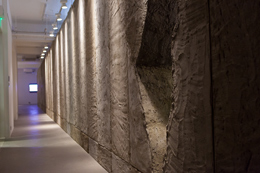
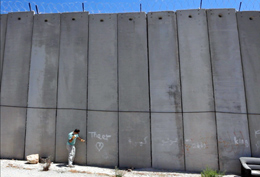
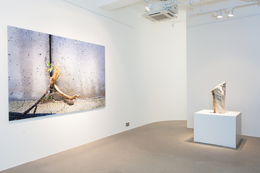
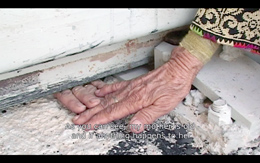
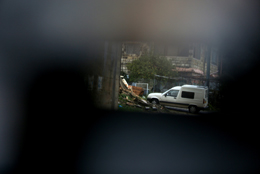
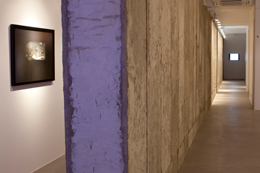
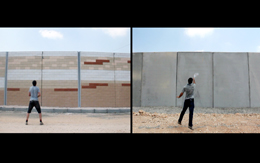
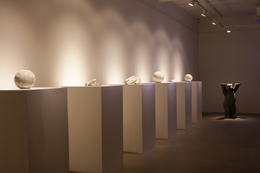
KHALED JARRARWhole in the Wall AYYAM GALLERY 143 New Bond Street W1S 2TP, London 20 JUN - 03 AGO 2013 Walls or fences are symbolic erections of seemingly powerplease scroll down for English version >>>>>>>>>>>>>> De uma das ruas londrinas mais elitistas, onde as pessoas circulam por entre um consumo imperialista, no topo de uma destas lojas de moda extravagantes, na Galeria Ayyam, somos convidados a visitar a primeira exposição individual no Reino Unido do artista palestiniano Khaled Jarrar, onde este revela-nos de forma crítica a vida quotidiana nos Territórios Ocupados da Palestina (OPTs). Não existe qualquer dúvida que as contínuas medidas políticas aplicadas por Israel ao povo palestiniano são um crime e estão em total violação da Lei Internacional. A exposição em questão, intitulada Whole in the Wall, revela-nos não só o impacto do Muro do Apartheid no quotidiano da população palestiniana, como também é um forte alerta para a segregação, discriminação e opressão que o Estado de Israel tem vindo deliberadamente a submeter o povo palestiniano. O Muro do Apartheid ou Muro de Separação, como os israelitas preferem denominar, começou a ser construído em 2002 no West Bank por “questões de segurança”. Tal como o ex-ministro de Jerusalém, Haim Ramon, afirmou em 2005 “acima de tudo [o muro] é para prevenir que continuem a assassinar-nos” [1]. No entanto, o percurso deste muro já ultrapassou a chamada “Green Line”, tendo-se expandido bem para dentro dos OPTs, serpenteando por entre quintais, cidades, apropriando-se de recursos naturais e consequencialmente deslocando e segregando comunidades e famílias. Este Muro, que ainda se encontra em construção (contra as ordens do Tribunal Internacional de Justiça), continua a ser usado como pretexto para a usurpação ilegal de terrenos para o Estado de Israel. Aquando terminado terá mais de 700 Km de comprimento, mais do dobro da própria “Green Line” [2], e segundo o relatório da ONU OCHA de 2008, encurralará por três flancos, mais de 125 mil palestinianos em vinte e oito comunidades, e por quatro flancos mais de 26 mil pessoas de oito comunidades [3]. Esta exposição é um confronto a este enorme Muro de cimento, e por tal, quando entramos na galeria Ayyam, o público defronta-se com uma imponente instalação site-specific, formada por uma parede de cimento com 2.5 m altura que divide longitudinalmente o espaço expositivo, ilustrando o impacto que tal estrutura teria no nosso quotidiano. Esta instalação, tal como a maioria das obras expostas, é literalmente composta por fragmentos do Muro de Separação de Israel, que o artista secretamente cinzelou do Muro na zona de Ramallah, durante o dia. Tal ação foi documentada no vídeo Concrete, presente nesta exposição. O artista ao reutilizar estes fragmentos do Muro e “traficá-los” para outros contextos e lugares, procura transverter este símbolo de opressão e humilhação numa fonte de união [4], e incitar uma discussão crítica sobre posse e recuperação. Khaled Jarrar acredita que “se todos nós nos juntássemos [o povo Palestiniano], lado a lado, e fizéssemos isto … o Muro cairia” [5]. Se somente o artista para esta exposição conseguira retirar mais de 50 kg do Muro, imaginem o resultado se todos os palestinianos se juntassem e decidissem derrubá-lo. Podemos ainda subentender este comentário de Jarrar como a necessidade do povo palestiniano de se unir e definir conjuntamente a sua estratégia para enfrentar o racismo, o apartheid e a opressão israelita. Nesta exposição o público é convidado a interagir com a sua instalação site-specific, atravessando um buraco existente na parede, sob a forma do mapa da palestina; ou então tomar o percurso mais inerte e complacente que contorna a instalação. O ponto de partida deste último trajeto é no fundo o ponto final da exposição se decidirmos passar o buraco, e foi como o artista idealizara o percurso. Ao extrapassarmos o buraco ficamos perante uma fotografia que retrata uma árvore que conseguiu penetrar por entre as juntas do Muro do Apartheid. À nossa direita podemos observar a escultura Olive Tree Stump, metade tronco de Oliveira e metade cimento. O artista utilizou especificamente a oliveira nesta escultura, não só devido ao seu significado cultural e identitário para o povo palestiniano, mas também como uma referência à devastação de milhares de oliveiras devido à construção deste Muro e à expansão dos colonatos israelitas. Como o escritor e poeta palestiniano Mohammed Ali Taha afirmou, estas são “o símbolo de estar firme à terra” [6] e por tal Jarrar utiliza a oliveira como símbolo da perseverança e resistência do povo palestiniano. Ao continuarmos o percurso, encontramos lado a lado a série de fotografias e o vídeo intitulados Whole in the Wall. Obras que exploram as fissuras existente no Muro do Apartheid, expondo tanto a paisagem do outro lado do Muro, como os contínuos problemas de restrição à mobilidade que os palestinianos encontram diariamente. Existem 63 postos de controlo e acessos no Muro da Separação de Israel, mas nem todos estão acessíveis aos palestinianos e a maioria possui um horário de funcionamento muito restrito [7]. Este Muro separa milhares de palestinianos e muitas famílias vivem mesmo em lados opostos do muro, impossibilitados de se verem. Uma destas famílias foi documentada no vídeo Whole in the Wall, um comovente vídeo que demonstra uma mãe e filha a trocarem carícias com as suas mãos através de uma pequena fissura debaixo do Muro, a única forma que encontraram para manterem o contato pessoal. Este vídeo, é na realidade um pequeno extracto do filme alargado Infiltrators (2012) de Khaled Jarrar, que documenta as lutas dos palestinianos para transporem o muro [8]. Apesar da obra de Jarrar expor uma agenda política intimamente correlacionada com os territórios e seus cidadãos, o artista afirma que os seus trabalhos não são políticos, são apenas uma observação crítica ao ambiente diário no qual ele e muitos Palestinianos têm vindo a sobreviver. A última fotografia da série Whole in the Wall marca o fim em comprimento da instalação site-specific do muro. Se prolongarmos um linha imaginária do muro encontramos na parede perpendicular a obra BADminton, um vídeo com alguns traços de humor, no qual podemos ver Jarrar e o seu amigo, o artista britânico Jeremy Hutchison, a jogarem badminton em lados opostos do Muro sem se conseguirem ver um ao outro. A televisão utilizada para apresentar este vídeo é colocada como que cada metade estivesse num dos lados da parede, correspondendo cada metade à imagem de cada um dos atores a jogar em lados opostos do muro. Jarrar encontra-se no lado da Palestina e Hutchison no lado Israel, como seria de esperar. Através deste vídeo podemos observar as diferentes características do Muro em cada um dos lados. Novamente, como esperado, o lado palestino é somente cimento ao passo que o israelita se encontra embelezado. Em alguma zonas do Muro, nomeadamente em Jerusalém, não retratada neste vídeo, o muro do lado de Israel é “pintado com uma paisagem campestre para além do muro – mas sem a cidade palestiniana, representando apenas a natureza, a erva, as árvores ... Não será isto uma limpeza étnica na sua forma mais pura, imaginando o exterior para além dos muros como deveria ser: vazio, virgem, à espera de ser ocupado?” [9]. Nas suas inúmeras visitas ao Muro, o artista tem observado muitas crianças a brincarem junto ao muro. Inspirado por uma história real que lhe foi partilhada por uma dessas crianças palestinianas, sobre o facto do seu recreio ter sido reduzido devido à construção deste muro, Jarrar desenvolveu uma série baseada em equipamento desportivo [10], o qual inclui as obras Volleyball, Ping pong, Football Shoes, Basketball, Discus Throw e Football, apresentadas nesta exposição. Outra obra escultórica, não associada ao desporto, é Buddy Bear, uma réplica do Buddy Bear original, um urso de brinquedo de braços abertos como se estivesse a pedir um abraço, que é o símbolo internacional para a tolerância e paz entre as nações. A primeira exposição do Buddy Bear aconteceu em 2001 junto ao sítio do Muro de Berlin e contou com 140 ursos, cada um representando um país das Nações Unidas. Em 2007 esta exposição foi apresentada em Jerusalém, tendo sido acrescentado um Buddy Bear palestiniano, exibido juntamente com todos os restantes ursos. Esta foi talvez um indício inicial do possível reconhecimento do estado da Palestina, algo que ainda não foi efetivamente concretizado. Em 2012, a Palestina passou do seu estatuto de “entidade observadora” para “Estado observador não-membro” e, muito recentemente, em abril de 2013, foi reconhecida por 132 dos 193 Estados membros da Organização das Nações Unidas. No entanto nenhuma destas ações teve algum efeito legal, visto que a Palestina enquanto entidade geográfica “não existe”, sendo apenas uma ideologia abstrata. A escolha de Jerusalém como cidade acolhedora deste evento expositivo é também de certa forma hipócrita, visto que esta detém parte do Muro de Separação que divide a própria cidade, resultando assim numa irónica exposição sobre tolerância numa cidade ocupada. Algo que pode ser equiparado à apresentação desta exposição em Berlin enquanto o Muro de Berlin ainda existia. Eventualmente, esta exposição pode ser encarada como uma forma de resistência não violenta ou um protesto contra o sistema hostil de apartheid que Israel tem desenvolvido durante mais de sessenta anos contra o povo palestiniano, e o artista, Khaled Jarrar, como um militante pela liberdade que usa a arte como uma plataforma pública reivindicativa impulsionando a discussão por entre a hegemonia dissidente. Este projeto já foi tomado como fonte de inspiração por um grupo de jovens ativistas palestinianos nas ruas do West Bank, um verdadeiro reflexo da forma como a arte pode instigar mudança. O jornal palestiniano Palestine New Network (PNN) publicou recentemente um artigo que mostra um grupo de ativistas da Popular Resistance aliados a uma dúzia de jovens palestinianos, na cidade de Abu Dis, a perfurarem o Muro de Separação com martelos, tendo conseguido abrir um buraco substancial, suficiente para permitir a passagem de uma pessoa. O gesto, apesar de poder ser interpretado como diminuto dada a extensão do Muro, é no entanto significante e fortemente simbólico. Este não é só um ato isolado contra o Muro de Separação e as diversas políticas de colonização, mas também uma comemoração do nono aniversário da decisão do Tribunal Internacional de Justiça da ONU, decretada em 2004, que criminaliza o Muro de Separação [11]. Na última década o mundo têm vido a despertar para a situação atual dos palestinianos, um exemplo é o crescente aumento da adesão à Campanha da sociedade civil palestiniana de boicote, desinvestimento e de sanções (Palestinian civil society campaign of boycott, divestment and sanctions - BDS). Ações postas em prática por este movimento certamente já tiveram repercussões no Estado de Israel, ou porque iria este aprovar em 2011 uma lei que criminaliza toda e qualquer contribuição ou suporte aos boicotes a Israel? [12] Israel tem sido criticado internacionalmente pelas suas políticas, e acusado formalmente por organizações internacionais de não respeitar a Lei Internacional, no entanto até agora, não foi visível a aplicação de qualquer forma de sanção. Países árabes são atacados pelo Oeste em nome da democracia, por serem liderados por governos autoritários que negligenciam os direitos da sua população. No entanto, onde é visível este comportamento no que diz respeito a Israel e às suas políticas para com o povo palestiniano? Onde estava a comunidade internacional quando se deu o Nakba? Ao invés de ser sancionado, Israel continua a ser apoiado. Desde 2006, Israel “tem vindo a desenrolar a sua criminalidade: expandindo os seus colonatos, lançando uma guerra ultrajante contra o Líbano, e impondo uma punição coletiva a Gaza através de um bloqueio brutal” [13], ao mesmo tempo que continua a ser suportado pelos Estado Unidos através de uma ajuda monetária anual de três mil milhões de dólares complementada por armamento, enquanto goza de uma “melhoria drástica das suas relações diplomáticas, culturais e de mercado com uma variedade de outros aliados” [14]. Interesses económicos e controlo Ocidental no Médio Oriente, através da presença de Israel (o único país não árabe no Médio Oriente, tão perto do valioso Canal do Suez – o acesso principal ao petróleo do Médio Oriente), acaba por prolongar a imunidade de Israel. Na guerra ocidental contra o terrorismo global, é interessante ver alguns dos seus principais atores a demonstrarem uma noção tão dúbia no que diz respeito ao significado de terrorismo. Dentro deste contexto global, com valores morais e éticos tão ambíguos, onde o dinheiro vale mais que a vida, é importante perguntar, quando é que será o tempo de liberdade para a Palestina? NOTAS [1] McGreal, Chris. “Wall makes Jerusalem’ more Jewish”, The Guardian, 2005. Link: www.guardian.co.uk/world/2005/jul/12/israel1 [2] Barrier to Peace: The impact of Israel’s Wall five years after the ICJ ruling, PLO Negotiation Affairs Department Report, 2009. Link: www.nad-plo.org [3] UN OCHA, The Humanitarian Impact of the Barrier: Update No. 8, 2008. Link: www.tinyurl.com/n6rwtp2 [4] Cementing Unity, Catálogo da exposição Whole in the Wall, Ayyam Gallery, Londres, 2013. [5] “The art of Palestinian resistance” – Reportagem por Simon McGregor Wood para a Al Jazeera, 2013. Link: www.tinyurl.com/moduzpc [6] Rooted to the Land, Metro Press, 2007. Link: www.metro-press.com [7] Barrier to Peace: The impact of Israel’s Wall five years after the ICJ ruling, PLO Negotiation Affairs Department Report, 2009. Link: www.nad-plo.org [8] Trailer: Infiltrators (Khaled Jarrar, 2012). Link: www.tinyurl.com/ln9lvlz [9] Žižek, Slavoj. What goes on when nothing goes on? , em The Case for Sanctions Against Israel, 2012. [10] Hatuqa, Dalia. “Biennale seeks to boost Palestinian art”, Al Jazeera, 5.11.2012. Link: www.tinyurl.com/meo8olv [11] Palestine New Network, 09/07/2013. Link: www.pnn.ps/index.php/policy/60675-pnn [12] A new Israeli law criminalizes support to Palestinian civil society campaigns, 2011. Link: www.tinyurl.com/k5m735z [13] Klein, Naomi. Israel: Boycott, Divest, Sanction, em The Case for Sanctions Against Israel, 2012. [14] Idem. >>>>>>>>>>ENGLISH VERSION WHOLE IN THE WALL KHALED JARRAR Ayyam Gallery 20.06.2013 - 03.08.2013 WALLS OR FENCES ARE SYMBOLIC ERECTIONS OF SEEMINGLY POWER by Inês Valle From one of the most fanciest streets of London where people roam among an imperialist consume, on the top of one of these extravagant fashion stores, we are invited to visit the premiere UK solo exhibition of the Palestinian artist Khaled Jarrar at Ayyam Gallery, where he critically unveils us the everyday life in the occupied Palestinian´s territories (OPTs). There are no doubts regarding the fact that the continuous measures applied by Israel’s policies to the Palestinian people are a crime and in a complete violation of the international law. The exhibition in question, titled Whole in the Wall, not only discloses us the impact of the Apartheid Wall in the peoples’ quotidian, but also is a stark reminder of the on-going exposure to segregation, discrimination and oppression that the State of Israel deliberately keeps subjecting the Palestinian people. The Apartheid Wall or Separation Wall, as the Israelis prefer to call, started to be built in the West Bank in 2002 and was justified by “security concerns”. As former Jerusalem’s minister Haim Ramon affirmed in 2005 “first and foremost [the wall is] to prevent them from continuing to murder us” [1]. But the wall’s route extends itself deeply inside the so-called “Green Line”, deep into OPTs, snaking through backyards, towns, and stealing natural resources, while furthermore displacing and segregating communities and families from one another. A wall that is still in construction (against The International Court for Justice orders), keeps being used as an excuse to illegally confiscate Palestinian lands to Israel’s side. Once completed, it will have in length more than 700 km, more than double of the “Green Line” [2], and according to the UN OCHA report, it will trap on three sides more than 125,000 Palestinians in twenty-eight communities and enclose 26,000 of eight communities on all the four flanks [3]. This exhibition is a confrontation to this all-concrete wall, and as such, the first impact that the audience has while entering it, is an imposing 2.5 metres high site-specific installation of a concrete wall that divides longitudinally the gallery, and acts as a way of showing us what the impact of such structure would be in our daily lives. This installation, as well as most of the artworks exhibited, is literally made from fragments from the Israeli Separation Wall, which the artist secretly chiseled from the wall near Ramallah during daylight – such action is documented in his video Concrete. By reusing these concrete wall fragments and “trafficking” them to other places or contexts, the artist hopes to elevate this symbol of oppression and humiliation to a source of unity [4], as well as, provoke a critical dialogue about possession and reclamation. Khaled Jarrar believes that “if we all together [the Palestinian people], hand by hand, do this… the wall would fall down” [5]. If the artist alone chiseled more that 50kg for this exhibition, image the result if all the Palestinians people decided to bring down this Wall. This can also be read as a need for the Palestinians to unify its strategy for confronting Israeli racism, apartheid and oppression. In this exhibition the audience is invited to interact with his site-specific installation by climbing through a hole in the concrete wall, shaped like the Palestine Map; or taking the inert and complacent path that circumvents the wall. The starting point of the latter route is actually the ending point of the exhibition if one transposes the hole in the wall, and was how the artist idealized it. By transposing the hole, we are faced with a photograph from the series Untitled, which depicts a tree that pierces between the junctions of the Apartheid Wall, and on the right a sculpture of a tree log titled Olive Tree Stump. Half of this sculpture is actually a piece of an Olive tree log and the remaining is concrete. The artist specifically uses olive trees due to their cultural and identity significance to the Palestinian people, as well as, to highlight the brutal destruction of thousands of olives trees due to Israeli settlement expansion and the Apartheid Wall’s construction. As Palestinian writer Mohammed Ali Taha said it’s “the symbol of being steadfast on the land” [6]. As such, Jarrar uses the olive tree as a symbol of perseverance and resistance of the Palestinian people. Along the exhibition’s main route, and side by side, are a short film and a series of photographs both titled Whole in the Wall. Both explore the existent fissures in the Apartheid Wall, showing us the panorama of the other, exposing ongoing issues of restricted mobility that Palestinians encounter daily. There are 63 checkpoints and gates in the Wall, but not all are accessible to Palestinians and the majority has restricted opening-hours [7]. The Wall separates thousands of Palestinians and many families are living on opposing sides of the wall, unable to visit one another. One of these families is portrayed in the video, a poignant short film where we see a mother and a daughter touching each other’s hands through a small fissure beneath the barrier, the only way they found to remain in touch. This video is actually an extract of a Khaled Jarrar’s longer film, Infiltrators (2012) that documents the struggles of Palestinians to infiltrate past this wall [8]. Though Jarrar´s work keeps on exposing a political agenda that is intimately aligned with the territory and its fellows citizens, the artist states that his artworks are not political, they are a factual reflection of the daily environment in which he and many others Palestinians have been surviving in. The last photo of the series Whole in the Wall marks the end in length of the wall installation. By extending the line of the wall, we find in the perpendicular wall a video with a trace of humour, BADminton. The television used to display this video is placed as if one its halves was in the Israeli zone and the other in the Palestinian, and in the video we can see Jarrar and his friend, the British artist Jeremy Hutchison, playing badminton, each in opposite sides of the wall without being able to see each other. Jarrar is on the Palestinian’s side and Hutchison on the Israeli’s, as it would be expected. Through it we can also observe the characteristics of the wall in each side. Again as expected, the Palestinian is just concrete while the Israeli is embellished. On some parts of the wall, namely Jerusalem, not depicted in this video, the Israeli side is “painted with the image of the country side beyond the wall – but without the Palestinian town, depicting just nature, grass, trees… Is this not ethnic cleaning at its purest, imagining the outside beyond the walls as it should be: empty, virginal, waiting to be settled?” [9] In his many visits to the Wall, the artist has encountered many children that play near the wall. Inspired by a story that some Palestinian children told him about the shrinkage of their playground due to the construction of the wall, the artist was inspired to do a sculpture series based on sporting paraphernalia [10], that include Volleyball, Ping pong, Football Shoes, Basketball, Discus Throw, and Football, shown in this exhibition. Another sculpture, not sports related, is Buddy Bear that is a replica of the original Buddy Bear, a toy bear with his arms up as if begging for a hug, and an international symbol for tolerance and peace among nations. The first exhibition of Buddy Bears took place in 2001 at the site of the Berlin Wall, with 140 bears each representing a United Nation’s country, and in 2007 the exhibition went to Jerusalem, where a Palestinian buddy bear stood in the same footing as all the others, an early sign of recognition of the Palestinian state, something that hasn’t been fully attained. In 2012, Palestine moved from its UN status from “observer entity” to “non-member observer state”, and very recently in April 2013, was recognized by 132 of the 193 member states of the United Nations as the State of Palestine. However none of these recognitions have had any legal percussion, since Palestine’s territory as a geographical entity “does not exist”, remaining an ideological abstraction. There is a hint of hypocrisy in the choice of Jerusalem as the hosting city, since its holds part of the Separation Wall, resulting in an ironic exhibition of tolerance in an occupied city. It could be seen as an equivalent to hosting the same exhibition in Berlin when the Berlin Wall still existed. Eventually, we may see this exhibition as non-violent resistance or a protest against the hostile apartheid system that Israel has been developing for more than sixty years against the Palestinian people, and Khaled Jarrar as a freedom fighter that uses Art as a challenging public platform to boost discussion among the dissident hegemony. This project might already been taken as a source of inspiration for young Palestinians activists in the streets of the West Bank, a true reflect of the way Art can promote change. The newspaper Palestine New Network (PNN) recently published an article, showing a group of activists of the Popular Resistance allied with the help of dozens of young men, in the city of Abu Dis, perforating the wall with hammers, being able to open a substantial hole in the Separation Wall, big enough to allow a person to pass through. A gest, that although may seem to be insignificant when compared to the whole dimension of the wall, is meaningful and strongly symbolic. This is not only an isolated act of protest against the apartheid wall and the several settlements activities, but also the marking of the 9th anniversary of the International Court of Justice’s decision in 2004, criminalizing the Separation Wall [11]. In the last decade the world has been awaking to the Palestinian actual situation, an example is the mainstream increase adhesion to the Palestinian civil society campaign of boycott, divestment and sanctions (BDS) movement. BDS’s actions may have already impacted the State of Israel or why would in 2011 it approve a law that criminalizes all that contribute or support boycotts of Israel? [12] Israel has long been internationally criticised by its policies, and formally accused by international organizations of not respecting the International Law, but until now there have been no visible sanctions. Arab countries are invaded by the West on the sake of democracy, on the excuse of having authoritarian governments that neglect their people’s rights. Nevertheless where is this behaviour to be seen in the case of Israel and its policies towards the Palestinian people? Where was the international community when the Nakba took place? Rather than being sanctioned, Israel continues to be supported. Since 2006 it “has been steadily escalating its criminality: expanding settlements, launching an outrageous war against Lebanon, and imposing collective punishment on Gaza through the brutal blockade” [13], while continuously being supported by the US through an annual aid of 3 billing dollars plus weapons, and enjoying a “dramatic improvement in its diplomatic, cultural, and trade relations with a variety of other allies” [14]. Economic interests and Western control in the Middle East, through Israel’s presence (the only non-Arab country in the Middle East so close to the valuable Suez Canal, the main access to the Middle Eastern oil), ends up enduring Israel’s immunity. In the western fight against global terrorist it is interesting to see that some of its main characters have a rather dubious notion of terrorism. Within these ambiguous ethical and moral values, where money is more valuable than life, it would be meaningful to ask, when is the time for Palestinian freedom? FOOTNOTES [1] McGreal, Chris. “Wall makes Jerusalem’ more Jewish”, The Guardian, 2005. Link: www.guardian.co.uk/world/2005/jul/12/israel1 [2] Barrier to Peace: The impact of Israel’s Wall five years after the ICJ ruling, PLO Negotiation Affairs Department Report, 2009. Link: www.nad-plo.org [3] UN OCHA, The Humanitarian Impact of the Barrier: Update No. 8, 2008. Link: www.tinyurl.com/n6rwtp2 [4] Cementing Unity, Exhibition’s catalogue Whole in the Wall, Ayyam Gallery, Londres, 2013. [5] “The art of Palestinian resistance” – Interview by Simon McGregor Wood for Al Jazeera, 2013. Link: www.tinyurl.com/moduzpc [6] Rooted to the Land, Metro Press, 2007. Link: www.metro-press.com [7] Barrier to Peace: The impact of Israel’s Wall five years after the ICJ ruling, PLO Negotiation Affairs Department Report, 2009. Link: www.nad-plo.org [8] Trailer: Infiltrators (Khaled Jarrar, 2012). Link: www.tinyurl.com/ln9lvlz [9] Žižek, Slavoj. What goes on when nothing goes on? , em The Case for Sanctions Against Israel, 2012. [10] Hatuqa, Dalia. “Biennale seeks to boost Palestinian art”, Al Jazeera, 5.11.2012. Link: www.tinyurl.com/meo8olv [11] Palestine New Network Newspaper, 09/07/2013. Link: www.pnn.ps/index.php/policy/60675-pnn [12] A new Israeli law criminalizes support to Palestinian civil society campaigns, 2011. Link: www.tinyurl.com/k5m735z [13] Klein, Naomi. Israel: Boycott, Divest, Sanction, em The Case for Sanctions Against Israel, 2012. [14] Idem.
|